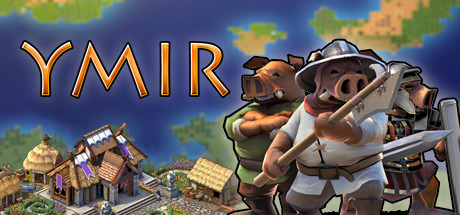
Ymir
Early access since Mar 2019
Ymir is a 4X multiplayer strategy game combined with a city builder where each player develops a civilization of pigmen starting at the stone age.
75% positive · 1,115 reviews
Not yet
In early access, content still planned
High confidence
Content Planned
Not yet
In early access, content still planned
High confidence
Content Planned
Where to buy
Steam $34.99
Can't confirm — worth a look
We couldn't confirm these stores carry this game.
Green Man Gaming Steam key Search IndieGala Steam key Search Prices in USD, as listed by each store.
Buying through an affiliate store helps support the site
Evaluation
Ymir is a solo-developed Early Access 4X multiplayer city-builder that has been in active development since its March 2019 launch. The developer, Thibaud Michaud, has maintained consistent communication and steady development activity throughout the game's lifespan.
The central ongoing effort is "New Dawn" — a ground-up engine rebuild and visual redesign that the developer describes as "basically a new game." Announced in September 2023, New Dawn introduces full 3D graphics with a custom rendering engine, spherical worlds with hexagonal territories, seamless zoom between world map and regional views (eliminating loading times), and major new gameplay mechanics including traffic systems, desirability maps, road access requirements, and overhauled battles.
In the most recent developer post on March 31, 2026, the developer announced that the "alpha" stage of New Dawn is now complete — all major technical unknowns have been resolved and the core engine features are implemented. However, the developer explicitly stated that substantial work remains: adding graphical content (particularly buildings, described as "a LOT of work"), polishing, optimization, bug fixing, and building out a new in-game encyclopedia called the Porcopedia. The developer also laid groundwork for additional planned features including ships and new unit types such as chariots.
The existing "legacy" version continues to receive maintenance, with a balancing patch posted on February 8, 2026. Prior to that, regular New Dawn progress updates were posted in April 2025, July 2025, and November 2025, demonstrating consistent development engagement across the year. The developer is funded partly through Patreon, where supporters get access to New Dawn work-in-progress builds. No release date for New Dawn has been announced. When it is ready, New Dawn will replace the current version as a free update, with the legacy build remaining on a separate Steam branch.
As of October 1, 2026, the last developer communication was on March 31, 2026 — approximately six months ago. This is at the edge of the developer's historical posting pattern (roughly quarterly progress updates), but given that the developer just completed the alpha milestone and described a large remaining workload, an absence of posts over this interval does not suggest a problem — it is consistent with a solo developer deep in a production push.
Evidence
Developer declares New Dawn alpha complete — all core engine features implemented — but states significant work remains including adding graphical content (buildings described as 'a LOT of work'), polishing, optimization, debugging, and building the Porcopedia in-game encyclopedia.
Developer announces New Dawn as a comprehensive engine and game overhaul, effectively a new game delivered as a free update to existing owners, with no release date given.
Media
Details
Developer
Publisher
Thibaud Michaud
Achievements
1
Platform
Windows
Controller
—
Steam Deck
Unsupported
Players
Single-player · Multiplayer · PvP
About this game
Ymir is a 4X multiplayer strategy game combined with a city builder where each player develops a civilization of Pigmen starting at the stone age.
The game is divided in 2 main interfaces : a worldmap view and a regional view. Each world tile matches a unique procedurally generated isometric zone that can be explored, settled and built on by players. In each one players can find random resources such as ores , animals or plants depending on the climate, relief and vegetation of the region.
The game is divided in 2 main interfaces : a worldmap view and a regional view. Each world tile matches a unique procedurally generated isometric zone that can be explored, settled and built on by players. In each one players can find random resources such as ores , animals or plants depending on the climate, relief and vegetation of the region.
Features
- Pigs with clothes.
- Multiplayer on local or persistent servers.
- Complex socio-economic simulator for a challenging city-building experience on its own.
- Technological evolution with hundreds to techs, from the stone age to post-iron age.
- Fully procedural worlds where each region is random and unique.
- 7 biomes, each one with its own specific resources to encourage player-trading.
- Advanced diplomatic and economic tools to setup treaties ( right of passage, taxes, payments, trade agreements... ) and trade routes between players.
- Real-time battles.
- WILL remain free of any pay-to-win .
Economy
- No direct control over population and economy: They breed, age, work and buy things according to the simulation.
- Population divided in social classes with specific incomes, purchasing power and revenues.
- Dynamic resources prices based on supply/demand, rarity and production costs.
- Even player consumed resources are taken into account: materials for buildings have to be bough at their market prices, generating incomes to the producers and affecting the economy.
- A simulator instead of a set of independent game rules : all variables and actions influence each other in sometimes unpredictable ways that makes things frustratingly challenging.
- Producing too much of something can be as damaging as not enough making the logic of the game quite different from classic management games. ( ex: instead of having positive effects, distributing a new resource can actually destabilize your economy if you're not careful )
Military
- Real-time battles are not instantiated and actually take place in your cities.
- Build and customize your fortifications with walls, bridges, gates, stairs, towers and battlements.
- With the terrain tools, modify the terrain heights to take maximum advantage of natural defenses like cliffs and hill tops.
- Water forces troops to embark and cross with slow vulnerable rafts: dig canals around your forts, secure your bridges or build a citadel on a river-island with fortified bridges.
- A Strategic-tool allows players to design their local defensive strategy in each one of their cities in case of attack: creating defensive zones, setting troops initial deployment positions and setting their behavior in battle.
- Battles are not instantaneous and belligerents can send reinforcements while a battle is still in progress.
- Battles can include unlimited 'teams' at the same time, each one fighting according to its allegiances.
- Battle troops during a battle are all AI controlled ( so that battles can happen independently of the player's presence ).
- Dozens of unit types including mounted camels, elephants and armored mammoths.
Main game modes
- Real-time mode : a 'classical' mode to be played alone or with a few friends, meant to be played with the permanent presence of all players and to be stopped/continued over several playing sessions.
- Persistent mode : a more "MMO" mode where the game server is to be left running 24/7 at all times even when players are offline and where actions take much more time than in the real-time mode. Meant to be played with the maximum number of players on a day-to-day basis, with games lasting several weeks.
IMPORTANT
- This game is a one-man project: development is slow.
- This game is likely to forever remain an experimental work-in-progress and to never reach the quality, stability and optimization of a finished product: buy it only if you think it's worth it NOW, and not based on future expectations.
- Playing solo is possible, but the main focus of this game is multiplayer.
- The game is available in more languages than English, but localization is done by the community and might be partial and incomplete.
Are these done yet?
Last evaluated Oct 1, 2026
Something about this evaluation looks wrong Report illegal or harmful content