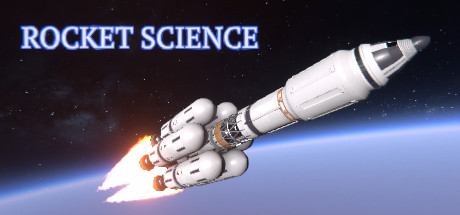
Rocket Science
Take part in a space program. Design spacecrafts and send them off to explore the vast expanses of space. Experience the real scale of the Solar system and the size of its celestial bodies.
Where to buy
Evaluation
Content
Media
Details
About this game
"Rocket Science" is a declassified Soviet Union space program that aims to conquer Mars and the entire Solar system. According to official documents that have been unearthed, it consists of the following main stages:
===== Source =====
Stage 1. From 20 February 2000 [Operational]
Transfer to a designated person control of an abandoned Soviet cosmodrome located at the coordinates 50° 35' 13" N and 130° 23' 50" E ... as well as all the stockpiled spacecraft components, so that assembly and launchpad operations can be carried out in order to find optimal configurations for putting cargo and satellites into Earth and near-Earth orbit.
Stage 2. [Approval in progress]
Organize the building of a new-generation space center on the cosmodrome site. Restrict the construction of surface buildings so as to ensure the facility's security and secrecy. Give the go-ahead for the construction and commissioning of underground facilities. Transfer the facility from state financing to full self-sufficiency.
Stage 3. [At the planning stage]
Conduct R&D on super-heavy rockets capable of delivering equipment, cargo and people onto the Martian surface. Start building an extraterrestrial base and ensure the continuous flow of supplies to it.
Stage 4. [Data corrupted]
===== End Source =====
Take part in the first stage of the space program right now!
Design
Assemble spacecraft and rockets from over 30 available parts with varying physical parameters. The parts can be joined together through a system of connectors and slots. This significantly reduces the number of non-viable configurations without limiting the flights of your imagination.
Launch
Put the rockets under your direct control or make flight plans and launch automated missions. But remember that going into orbit around a real planet is far more complicated than orbiting an asteroid.
Explore
You've never been on Everest? Have you dreamed of visiting the Moon? Just send a spacecraft there and enjoy the view you'll get.
Additional game features
The Solar system and celestial bodies are modeled to scale (currently all inner planets and their sattelites are available for exploration).
A physically accurate simulation of the Earth's atmosphere with a seamless transition into space will make your game session unforgettable.
The planets' surfaces are generated from NASA elevation maps, and a procedural approach control is used to add fine detail.
Realistic rocket physics and orbital mechanics.
Speeding up of time by a maximum factor of 10 even while the engines are running.
More than 75 parts are available to design your dream spacecraft: command modules, engines and fuel tanks, control and orientation systems, structural elements, decouplers and docking ports, as well as batteries and solar panels.
Detailed configuration of some rocket parts and the ability to change their physical parameters.
The engines use real fuel pairs rather than an abstract "fuel" and "oxidizer".
And much more in future updates. You can examine the development plan in the Early Access section of the game page.