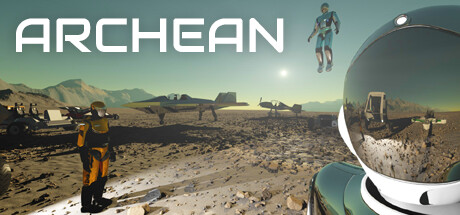
Archean
Gather resources, craft components, build vehicles, and code their logic in a physics-driven engineering sandbox and full scale space sim.
Where to buy
Evaluation
Media
Details
About this game
Archean is an immersive Engineering Sandbox and Space Sim.
The only tech tree is the one in your head. Archean simulates aerodynamics, orbital mechanics, fluids and electricity from the actual shape and wiring of your builds, then hands you an in-game programming language and gets out of your way.
No unlocks, no invisible stats doing the work. If your plane flies, it's because you built a plane that flies.
In other words, we simulate real physics and let you figure out the rest.
This game (and custom engine) is developed by a passionate team of two, and will stay that way.

Engineering is the game.
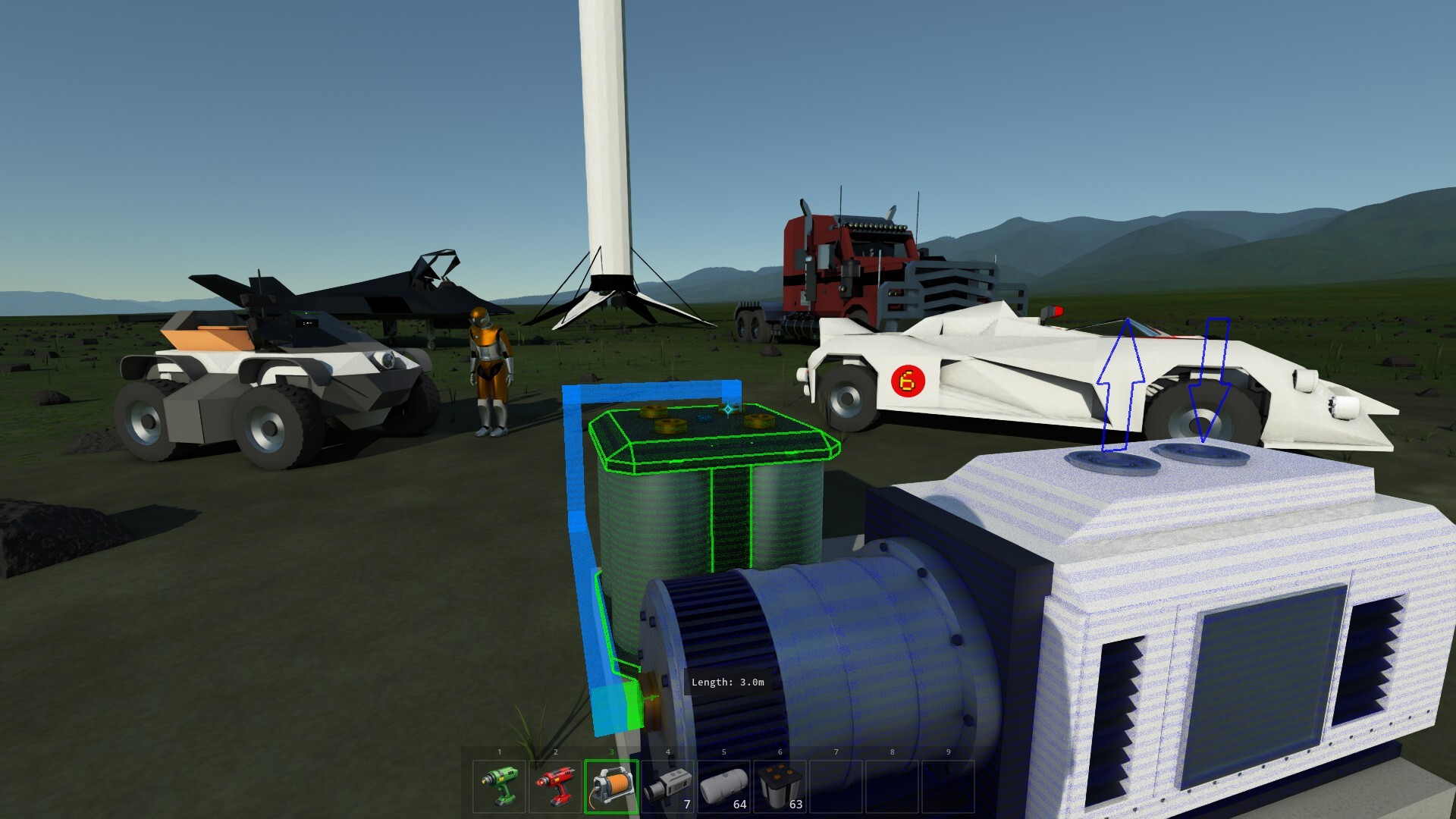
There's no separate build editor. You build everything in the world, in first person, standing on the half-finished wing.
If it looks like a wing, it flies like a wing.
There are no wing blocks. Lift, drag, stall, stability, control authority. All of it is computed from the actual shape of your build. Air and water run on the same physics too, so a wing turns into a hydrofoil as it dips underwater. Planes, boats, submarines, re-entry vehicles: same rules, different shapes.
Wire it. Program it. Trust it with your life.
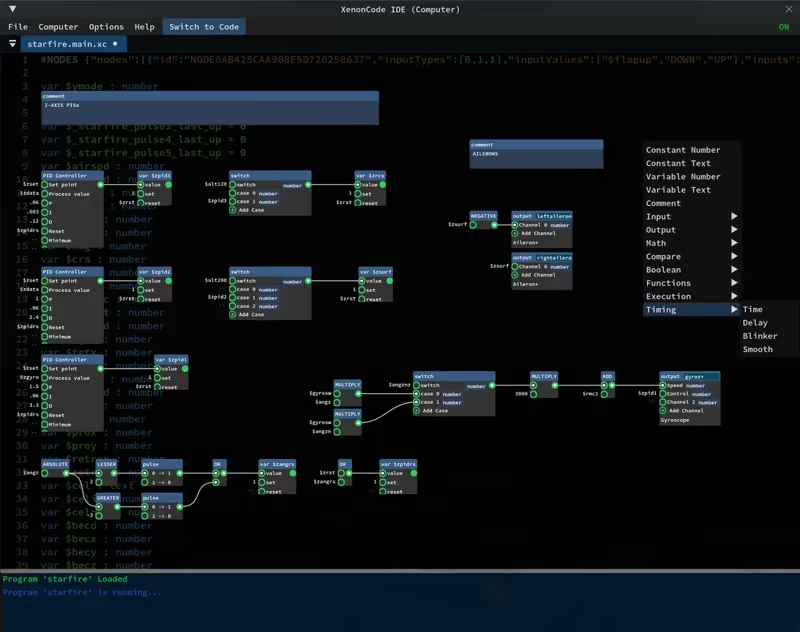
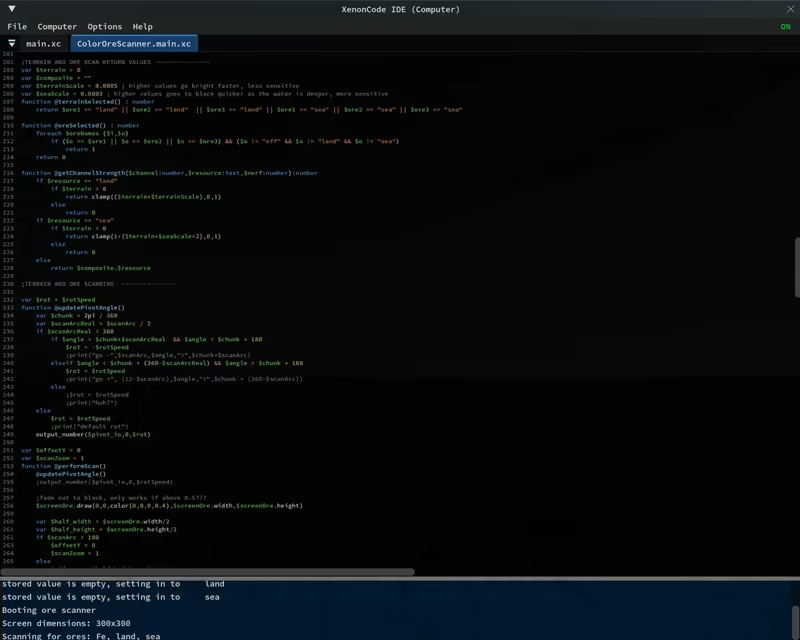
Every build is a machine: power, fuel, fluids, sensors, thrust. Hook them up however you want, then program the behavior yourself in XenonCode, our in-game programming language, or drag wires in the visual node editor if that's more your thing. Autopilots, launch sequencers, docking computers, mining rigs. Yours to write, yours to debug.
Space, at full scale.
Planets are real-sized and real distances apart. You will never run out of map. Orbital mechanics run in real time: you can dock at your friend's station while both of you are tearing around the planet at orbital velocity. There's no speed limit either. Keep accelerating up to 0.99c, just remember that slowing down is your problem. And if a two-body approximation offends you, full n-body physics is one config line away.
Sunrise isn't a timer.
The day-night cycle isn't scripted. Planets actually spin, with axial tilt, while orbiting the sun. When dawn comes, it's because the ground under your feet rotated into the sunlight. Build a solar farm and you'll start caring exactly how long that takes.
Yes, you are walking on a sphere the size of the earth, not just a flat map.
The Earth, before anyone.
A full-scale young Earth: real topography, the Moon is huge in the sky, nothing alive yet but the green stuff. You're the first engineer this planet has ever had.
Seal it, pressurize it, live in it.
A cabin either holds pressure or it leaks. Compartments are scanned voxel by voxel for airtightness, and your spacecraft, submarine or airship has to actually pass that test. Then walk through the thing in first person, from the reactor room to the cockpit.
Voltage, plumbing, and thermodynamics.
Electricity comes in low and high voltage, with relays, junctions and converters in between. You design the grid, not just the generator.
Earn every part.
Adventure mode starts you with bare hands on a planet. Scan for ore, dig it up, crush it, craft it. Every part of your ship started as a rock somewhere. If you'd rather skip straight to engineering, Creative mode gives you everything from the start.
Damage isn't a health bar.
Things break the way they were built: physically. A damaged wing sheds lift and gains drag. Now you're wrestling a plane that pulls to one side. Take good care of your vehicles and they'll serve you well!
Gravity is something you engineer.
There is no gravity-generator block. Want weight in deep space? Burn at a steady 1 g, or spin your station and live on the inside of the ring. Centrifugal force is a thing, Coriolis wobble included.
Alone, or with people as obsessed as you.
Play solo, with friends, or on public servers. Each server sets its own rules, star systems and mods. And the whole thing is fully ray-traced, because we're rendering nerds too.
Your solar system is a config file.
Mass in kilograms, orbits in meters, atmospheric composition by mole fraction. Our default Moon orbits at geosynchronous distance, but a few edited lines give you the real present-day solar system, or one that never existed.
Built to be modded.
Create a mod from inside the game, model your component in Blender with our official plugin, script its behavior in XenonCode (screens, animations, ports and all), then drop in a YAML file to make it craftable. Every server picks which mods it runs. If you can imagine a component, you can ship it.
The short version:
Shape-based aerodynamics, no wing blocks
In-game programming: XenonCode + visual nodes
Real-time orbital mechanics
Full-scale planets
No artificial speed limit
Day-night cycle from real planet rotation
Pressurization and air-tightness
First-person, walk anywhere
Adventure and Creative modes
Explosions and destruction
Custom Dashboards and HUDs
Solo, co-op, or public servers
Fully ray-traced
Our five commandments
1. Thou shall obey physics
It's NOT arcade-style and we do not underestimate our players.
2. Thou shall not see "Loading..."
Seamless transitions, no loading screens, EVER!
3. Thou shall not hit a wall
No fake boundaries. No skyboxes. No predefined paths.
4. Thou shall not be Thee
Immersive, first person controls and no cutscenes.
5: Thou shall make sense
Everything has a realistic purpose based on science.
XenonCode
We have developed a new programming language designed to be easy to learn and optimal for in-game virtual computers.
The game has a built-in cooperative editor with syntax highlighting and multi-cursor support, as well as a node-based visual editor to facilitate scripting.