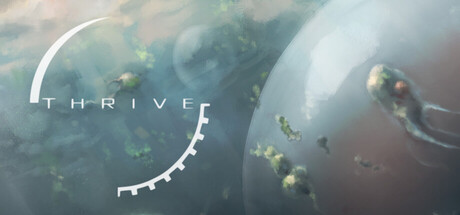
Thrive
Early access since Nov 2021
An evolution simulation game. Take control of your species in the environment and edit your species as a whole. Compete with other evolving species for resources on an alien planet.
92% positive · 1,733 reviews
Not yet
In early access, content still planned
High confidence
Content Planned
Not yet
In early access, content still planned
High confidence
Content Planned
Where to buy
Steam $4.99
Can't confirm — worth a look
We couldn't confirm these stores carry this game.
Green Man Gaming Steam key Search IndieGala Steam key Search Prices in USD, as listed by each store.
Buying through an affiliate store helps support the site
Evaluation
Thrive is an Early Access evolution simulation game with an ambitious 9-stage roadmap. On December 17, 2025, the developer released version 1.0, marking the completion of the Microbe Stage — the first of the nine planned stages. Rather than being a signal that the game is finished, this milestone explicitly kicked off the next phase of development. The developer stated that work would shift to the Multicellular Stage, with a target of completing it and releasing version 2.0 within approximately one year (i.e., by end of 2026).
Development has continued at a strong and consistent pace since then. Version 1.0.1 shipped on March 7, 2026 with initial Multicellular Stage improvements. Version 1.1.0 followed on May 23, 2026 with expanded Cell Specialization and a new Sporulation reproduction mode — and that post reaffirmed confidence in finishing the Multicellular Stage by end of 2026. Most recently, on August 22, 2026 — just five days before today — the developer announced a public beta for version 1.6.0, introducing multicellular reproduction modes (including colony membranes and initial auto-evo for the Multicellular Stage), with the stable release expected approximately one week later.
The game is in vigorous, ongoing Early Access development. The developer communicates regularly, ships major updates roughly every 2–3 months, and has a clearly stated roadmap. The current Steam Early Access flag reflects this status accurately — a large portion of the planned game (seven stages beyond Multicellular) remains to be built.
Evidence
Public beta for version 1.6.0 announced, adding multicellular reproduction modes, colony membrane improvements, and initial auto-evo for the Multicellular Stage. Full release expected approximately one week after August 22, 2026.
Version 1.1.0 released with expanded Cell Specialization system, adjacency bonuses, and new Sporulation reproduction mode. Developer reaffirmed confidence in finishing the Multicellular Stage before end of 2026.
Content
1 of 1 released · no outstanding content
Media
Details
Developer
Publisher
Revolutionary Games Studio
Achievements
12
Platform
Windows, macOS, Linux
Controller
—
Steam Deck
Playable
Players
Single-player
About this game
In Thrive, you take control of an organism on an alien planet, beginning with the Last Universal Common Ancestor (LUCA). Your goal is to survive in the environment, adapt your species by adding mutations, and thrive. Other species will emerge to compete with yours. They will evolve via a population dynamics driven simulation with random mutations - you must improve and spread your species to surpass them. The success of your species depends both on your skill in surviving as an individual and the changes you make in the editor.
In the Microbe Stage, which is the first and only complete stage of the game, you control a single microbe or a colony of microbes bound together. You swim through a watery environment to find the resources your cell needs to stay alive and to reproduce. Once you have reproduced, you enter the editor, where you can review how well your species and others are surviving, move to new biomes. And then modify your species: add new organelles, change your membrane, modify your cell's visuals, environmental tolerance and behaviour. Your goal is to become a more complex lifeform by first evolving the nucleus to become a eukaryote, then using binding agents to form cell colonies, the precursor to the first multicellular lifeforms.
The Multicellular Stage adds the ability to place multiple cells and customize their types. Your species will still interact with other microbes in the familiar microbial environment, but with new abilities and size that allows taking over the microbial world. This stage of the game is quite developed but multicellular-specific gameplay is still somewhat limited. Even further stages are included with the game but they are mostly just prototype level examples to show off our future vision.
The major goals of Thrive are to create engaging, compelling gameplay that respects our players’ intelligence, and remain as accurate as possible in our depiction of known scientific theory without compromising the former. Thrive is an open-source project, and anyone with game development skill is welcome to join our team. The game uses the open-source Godot Engine with the C# programming language.
If you don't have game development skills, you are still welcome to join our fan community. We would love to have you along for the long ride!
Create your own Species
Use over 25 different parts to create your own unique species. Place mitochondria to power your cell, use chloroplasts to eat sunlight, or add a pilus to stab unsuspecting prey. Keep the membrane of your cells flexible to eat others in one bite, or add a tough cell wall to protect yourself. The choice is yours, as you evolve to survive.Fight to Survive
Travel through your environment, collecting the resources you need to survive and reproduce. Gather them from clouds and chunks, or steal them from other species and use every tool you gave yourself in the editor to prevent being eaten by someone else.Evolution Simulation
Watch as the other species of the world evolve alongside you. They adapt to become ever better at surviving. Whether that be by becoming stronger and more efficient in using their food sources, avoiding predation, or choosing to become better at hunting you instead.A Dynamic World
Explore a world of different regions with varying environments. Choose to live anywhere from scalding hydrothermal vents in the deep sea, to freezing ice shelves on the surface. Even these environments themselves don’t stay the same; an asteroid impact or a global ice age might just ruin the day of photosynthesising bacteria.A Variety of Playstyles
Use one of many ways to survive and thrive. Try a different gameplay style each playthrough, feeding yourself with photosynthesis, by turning poisonous hydrogen sulfide into sugar, burning chunks of iron, or even more exotic methods. Or, instead of making your own food, just eat everyone else.And More
- Learn about biology by using real compounds, organelles or parts inspired by real science
- Review and plan future actions by looking at population simulation results and graphs
- Use endosymbiosis to turn other species into a part of yourself
- Learn the basics of the game with a light, interactive tutorial
- Create experimental species in freebuild mode with removed editing limits
- Play the in-development version of the next stage and see prototypes of future stages
The Present And The Future
In the Microbe Stage, which is the first and only complete stage of the game, you control a single microbe or a colony of microbes bound together. You swim through a watery environment to find the resources your cell needs to stay alive and to reproduce. Once you have reproduced, you enter the editor, where you can review how well your species and others are surviving, move to new biomes. And then modify your species: add new organelles, change your membrane, modify your cell's visuals, environmental tolerance and behaviour. Your goal is to become a more complex lifeform by first evolving the nucleus to become a eukaryote, then using binding agents to form cell colonies, the precursor to the first multicellular lifeforms.
The Multicellular Stage adds the ability to place multiple cells and customize their types. Your species will still interact with other microbes in the familiar microbial environment, but with new abilities and size that allows taking over the microbial world. This stage of the game is quite developed but multicellular-specific gameplay is still somewhat limited. Even further stages are included with the game but they are mostly just prototype level examples to show off our future vision.
The major goals of Thrive are to create engaging, compelling gameplay that respects our players’ intelligence, and remain as accurate as possible in our depiction of known scientific theory without compromising the former. Thrive is an open-source project, and anyone with game development skill is welcome to join our team. The game uses the open-source Godot Engine with the C# programming language.
If you don't have game development skills, you are still welcome to join our fan community. We would love to have you along for the long ride!
Are these done yet?







Last evaluated Aug 27, 2026
Something about this evaluation looks wrong Report illegal or harmful content